
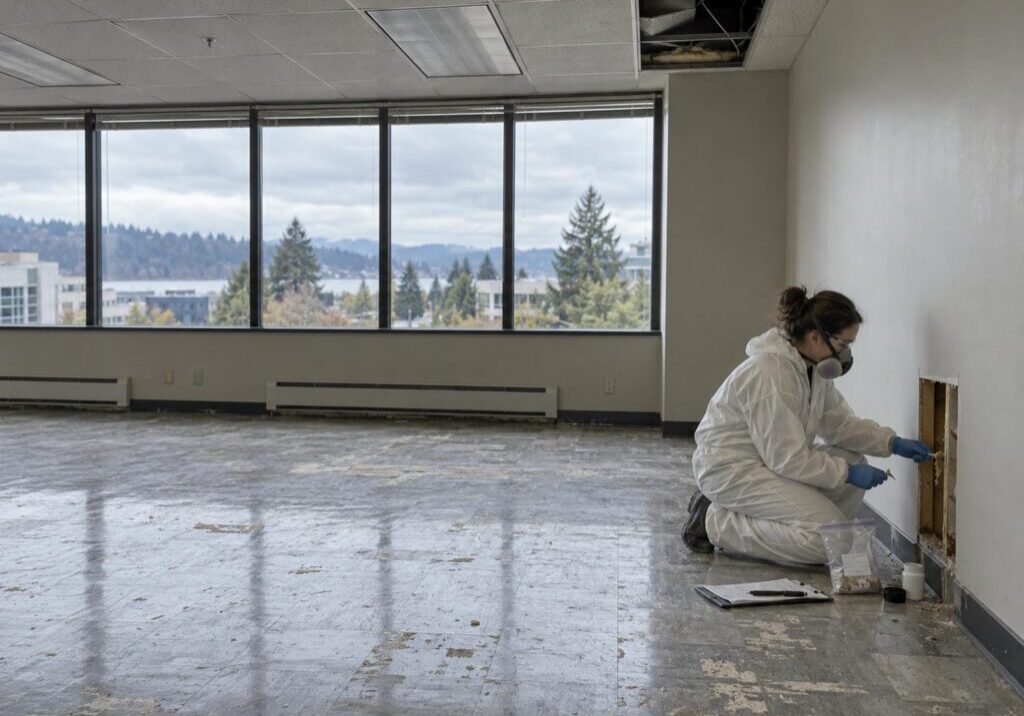
Before demolition, salvage or renovation work starts on a commercial space, someone qualified has to inspect the building and the worksite and identify the hazardous materials in it. That duty sits in front of your fit-out, not behind it. In a building that went up before 1990, the working assumption is that asbestos is in there somewhere until sampling rules it out. A hazardous materials survey for a BC tenant improvement is what turns that unknown into a priced, scheduled, removable item with a location on a drawing. So it belongs in the calendar before the drawings are locked rather than after the trades arrive, and on commercial tenant improvements in older Lower Mainland buildings it is the single step that moves every other date.
What a Hazardous Materials Survey Is, and What It Produces
Before work begins on the demolition or salvage of a building or structure, or the renovation of one, all employers responsible for that work and the owner must ensure a qualified person inspects the building and the worksite to identify the hazardous materials in it. The surveyor needs to know what the fit-out actually touches, because the sampling follows the demolition drawing.
Why Sampling Beats Looking
You cannot identify what is behind a finish by looking at the finish. Asbestos in a drywall joint is indistinguishable from drywall, and a textured ceiling tells you nothing about what is in it. So the qualified person collects representative samples of the material that may be hazardous, identifies each sample and determines whether it is hazardous material, uses other sufficient means where sampling is not practicable or appropriate, and determines the location of each material found. That is also why access matters: samples come out of walls, floors and ceilings. A non-destructive survey done for a property purchase is rarely enough to build from.
What the Report Has to Contain
The inspection ends in a written report, and the regulation sets out what has to be in it:
- where each sample was taken
- what each material was identified as
- the methods used to identify it
- the locations of the identified materials, shown on drawings or plans
- the approximate quantity of each hazardous material found
Read that list as a buyer rather than as a compliance item. Locations and quantities on a drawing are the only form in which an abatement contractor can price the removal, and they are what lets you decide whether a wall comes out or moves. A report that says asbestos was found in the suite, with no plan and no quantities, is not a survey you can build a schedule from.
The Report Lives on the Job Site
Every employer responsible for work on the worksite, and the owner, has to make sure the report is available at the worksite. It is a working site document, not a filing. For a tenant that means the copy that matters is the one the crew can put their hands on in the suite, and it is the same document the abatement scope, the abatement price and the trades’ right to start all run on. Keep it on site where the crew can find it.
Why 1990 Is the Line Everyone Starts From

Before 1990, asbestos was mainly used for insulating buildings and homes in Canada against cold weather and noise, and the material had left the Canadian market by the mid-to-late 1980s. 1990 is also the year WorkSafeBC treats asbestos as likely, and the line Metro Vancouver’s waste centres use for drywall. The duty to look comes from somewhere else, and it does not depend on a date.
Why an Older Building May Still Have It, and Lawfully
Asbestos was not prohibited in Canada until 30 December 2018, when the federal prohibition on importing, selling and using processed asbestos fibres came into force. And that prohibition expressly does not reach asbestos that was already integrated into a structure before it took effect. So a 1970s office block keeps lawfully what it was built with, and nobody has to remove it because the law changed. Read those two facts together and the question changes shape. It was never whether the material was allowed to be there. It is whether anyone is about to disturb it, because that is where the duty bites and that is what your demolition plan decides.
The Line Has a Specific Material Behind It
Metro Vancouver’s position on gypsum is the most concrete version of the 1990 line a tenant will meet. Gypsum installed before 1990 may be contaminated with asbestos in the tape and the mud, and should not be disturbed or removed without protective equipment. Think about what that means on a fit-out. The most ordinary demolition there is, taking down a few walls of drywall to open up a floor plate, is exactly the work the line is about. Not a boiler room, not sprayed fireproofing in a plant room: the wall between your reception and your meeting room.
A Newer Building Is Not Automatically Outside It
The duty to have a qualified person look attaches to the renovation of a building, so it does not switch off at a construction date. And a construction date describes the shell, not the finishes. A 1996 suite that has been fitted out twice since, with a suspended ceiling, broadloom and drywall installed over whatever was there before, is still a sampling question, and so is a 2005 shell where a previous tenant brought in salvaged material. Past 1990 you are arguing against an assumption with evidence. Before 1990 you are confirming one.
What a Survey Looks For Beyond Asbestos

The regulation’s own definition of hazardous material names asbestos-containing material, lead or any other heavy metal, and toxic, flammable or explosive material. A survey in practice looks for several other things as well, each under its own rule, because the lighting, the thermostats, the caulking, the flooring mastic and the old rooftop unit all have separate answers and separate people who deal with them.
| Material | Where It Shows Up in an Older Commercial Suite | The Era That Matters | What It Changes About the Work |
| Asbestos | Drywall joint compound and tape, textured and sprayed ceiling finishes, vinyl and linoleum flooring and its mastic, pipe and mechanical insulation, stucco and render | Used in building materials from the 1950s to the 1990s | Containment or removal before any work that may disturb it, plus at least 48 hours’ notice to WorkSafeBC before asbestos work starts |
| Lead | Paint, including paint on steel and on older trim and door frames | Paint applied before 1990 | Named in the regulation’s own definition of hazardous material, and significantly disturbing lead-containing material triggers the same at-least-48-hour notice |
| PCBs | Fluorescent lighting ballasts, caulking, grout, expansion joint material, paint | Ballasts manufactured before 1980 | They leave the building through an authorized hazardous waste company, not with the fixtures and not with the electrician |
| Mercury | Straight and linear fluorescent tubes, and older thermostats and switches, in offices, stores and warehouses | Not era-specific | A separate waste stream rather than the demolition bin, with the destination set by your municipality |
| Mould | Behind finishes in areas that have taken water | Not era-specific | Notice of project required for remediation, cleanup or demolition of a mould-contaminated area greater than 10 contiguous square metres (100 contiguous square feet) |
| Silica | Concrete, concrete block, cement and mortar, masonry, tile and brick, and drywall filler compounds | Not era-specific: as present in new concrete as in old | The work creates the hazard, so where a risk assessment indicates exposure a qualified person develops an exposure control plan before cutting, grinding, coring or drilling |
| Ozone-depleting substances | Older split systems, coolers and walk-in units | Not era-specific | The refrigerant is recovered before the equipment is dismantled or taken away |
Removing It Is Not Always the Right Answer, and Not Always Your Trade’s Job
Start with the removal reflex, because it is often wrong. Asbestos is safe while it is left alone and in good condition, and leaving lead-based paint in place is sometimes safer than taking it off. Where paint does come off, sanders, heat guns and blowlamps are not how, because they turn a stable coating into toxic dust and fumes.
Second, some of this is not your trade’s work at all. Only an authorized hazardous waste company may remove PCBs from the owner’s property, so the electrician swapping your fluorescent troffers for LED panels is not the person who deals with the old ballasts.
Third, the silica question is answered with a plan rather than a removal. Where a risk assessment indicates workers may be exposed to respirable silica dust, a qualified person has to develop an exposure control plan before anyone cuts, grinds, cores or drills. The work method changes.
Who Is Allowed to Do the Survey

In British Columbia this is a compliance decision as much as a procurement one. There are two separate things you can check before you engage anyone: what the firm holds, and what the person who actually walks your suite holds. They are different instruments.
The Test Is Training Plus Experience
A qualified person, for this duty, is someone who through education and training has knowledge of the management and control of the hazardous materials in the building or at the worksite, and who has experience in the management and control of those materials. Both halves are required, and the second one is the one that gets waved through. The regulation names no certificate for the inspection itself, so “certified inspector” is not the standard and asking for a certificate is not how a tenant checks this.
Since 2024 the Asbestos Sampling Itself Is Licensed Work
As of 1 January 2024, asbestos abatement contractors must be licensed to operate in British Columbia, and anyone performing asbestos abatement work must be trained and certified. Both requirements landed on the same date. And asbestos abatement work is defined to include identifying material that is or may be asbestos-containing, collecting samples of it, assessing the risk it poses, and planning or supervising any of that. So the firm doing the asbestos part of your survey is carrying out licensed activity. Sampling for lead, mould, PCBs or mercury is not licensed activity, so a consultant without an asbestos licence is not automatically the wrong consultant. The change came out of 2022 amendments to the Workers Compensation Act.
Level S Is the Certificate for the Asbestos Survey Work
WorkSafeBC’s asbestos certification runs in levels, and one of them exists for exactly this work. Level S, Surveyor Safety, has a scope of practice of performing asbestos surveys, with Level 1 as its prerequisite, and certificates are valid for three years from the date they are issued. Hold the two instruments apart in your head. The licence belongs to the firm and sits on a public registry you can search. The certificate belongs to the individual standing in your suite with a sample bag, and it is something you ask that person to show you.
Check Both Before You Engage Anyone
WorkSafeBC maintains a public registry of licensed asbestos abatement contractors, updated daily, so you can confirm the firm quoting your asbestos work holds a valid licence before letting it carry the work out, and ask the individual for a current Level S certificate at the same time. That is ten minutes of work and the most useful ten minutes in the subject.
One boundary, so you do not reject a competent firm over the wrong document. An organization doing asbestos work on its own building does not need a licence, and a general contractor coordinating a multiple-employer site is outside the requirement where its own employees are not doing the abatement. Workers doing the work still have to be certified even where no licence is required.
Where the Hazardous Materials Survey Fits in Your Tenant Improvement Schedule

This is a leasing and design decision before it is a construction one. A tenant who samples during due diligence can price the abatement before signing anything. A tenant who samples after possession has already accepted the risk and is now negotiating with a calendar, a landlord’s fixturing period and a laboratory, all at once.
Sample Before the Drawings Are Locked
Material that is left undisturbed can often stay where it is, which turns the survey into a design tool rather than a cost. A partition that lands 300 mm to the left of a joint that sampled positive avoids an abatement entirely. A doorway moved to the next bay avoids opening a floor assembly. None of that is available to you if the survey chases the drawings instead of preceding them, which is why the sampling belongs in the same conversation as the layout, power and data planning rather than arriving after those decisions are settled. By the time a design is issued for permit and pricing, the cheap version of the answer has gone.
Getting Into the Space to Sample Before You Sign
Sampling properly means opening things up, and before possession that needs the landlord’s written permission and a time to be in the space. It is a normal thing to ask for during due diligence and an awkward thing to ask for once the lease is signed, which is the practical reason to raise it while the offer is still being negotiated.
Three things are worth settling in that same conversation. Access for a short scheduled visit, with a date rather than a promise. Who makes good the sample holes afterwards, because a destructive survey leaves holes in walls and ceilings and somebody has to patch them. And whatever hazardous materials reports the building already has, which cost nothing to ask for. Put all three in writing with the offer, and the sampling stops being a favour you chase in week one of your fixturing period.
The Two Fixed Points You Can Plan Against
Two dates in the hazmat leg behave like hard constraints rather than preferences.
- Asbestos work needs at least 48 hours’ notice to WorkSafeBC before it begins.
- No demolition, salvage or renovation work that may disturb the material goes ahead until that material has been removed or safely contained, and a qualified person has confirmed that in writing.
Everything else is laboratory time and crew availability. Samples go to a laboratory, and that is real time in the schedule rather than a formality, so book the sampling early enough that the results are back before the demolition crew is. Keep the two notices apart while you are planning: the ordinary construction notice of project is 24 hours and has its own separate triggers.
When Something Turns Up After Work Has Started
Where material that may be hazardous is discovered after a qualified person has already given the written confirmation, the identification obligation reopens. One unexpected material restarts the sequence: identify it, sample it, report it, remove it or safely contain it, confirm that in writing again, and give at least 48 hours’ notice again if it is asbestos work. That is why a thin sample count is not a cheaper survey, it is a deferred one. The surprise behind the wall arrives with a stood-down crew attached to it, and it always costs more than the sample would have.
Who Decides What Gets Filed, and the Part That Does Not Vary
What has to be filed about hazardous materials, and when, is set by the city the space is in rather than by the province. Richmond publishes its requirements as a building bulletin called Hazardous Materials Reporting and Abatement Requirements, and its neighbours write theirs differently. Ask whichever city your space is in what it wants with the application and what it wants on site, and get the answer in writing before you build a schedule on it, the same way you settle which permits a Vancouver fit-out needs.
What does not change from one city to the next is the part that governs your start date. Before the work begins, someone qualified has to inspect the space and identify what is in it, and the report has to be available at the worksite. Anything found has to be removed or safely contained, with written confirmation, before the trades touch it. That duty is provincial, and it applies whether or not your city asks to see any of it.
What Happens to It Once It Comes Out

Two sets of rules land on the same skip. The rules about removing the material are WorkSafeBC’s, and the rules about the waste it becomes are the Province’s. Waste asbestos is hazardous waste here, and it goes to an approved authorized landfill rather than into the mixed demolition bin at the back of the building.
What an Abatement Actually Involves
Before anything comes out, a qualified person assesses the material and classifies the work as low, moderate or high risk. The controls follow from that classification rather than from the size of the job, which is why two abatements can look nothing alike. A qualified person has to ensure, and confirm in writing, that the identified materials have been removed or safely contained. Until both of those are true, the demolition that might disturb them has no lawful start. A verbal “it’s fine” is not the gate.
The Gypsum Gate at the Recycling Depot
Metro Vancouver’s recycling and waste centres accept gypsum for recycling where it is date-stamped 1990 or newer, and each load has to arrive with a signed declaration and acknowledgement form. So the drywall coming off your demising walls needs its paperwork before it needs a truck, and the yard is not where you want to find that out. The mechanical side has its own version of this: the refrigerant in older air conditioning and refrigeration equipment has to be recovered before the equipment is dismantled or disposed of, so the rooftop unit cannot simply be craned away.
What Drives the Cost, and Why the Survey Moves Every Other Number
A survey is priced off how many samples it takes and how much of the space has to be opened up to reach them, so the number comes from the consultant once they have seen the demolition drawing. A survey scoped to “the suite” and one scoped to four named walls, one ceiling and one floor assembly are different jobs at different prices.
Abatement is priced off the survey. That is why the first real figure for the removal arrives after the laboratory results do and not before, and why any removal number quoted before sampling is a guess. Volume is what tips a removal from a small line item into a large one, because past a certain quantity the waste has to be registered and manifested.
The notice periods then set the earliest lawful start, so the sampling date is what the rest of the schedule hangs from. Against a lease and a fit-out budget, the survey is the smallest of these numbers and the one with the most leverage over the others. It is also the only number on the list that can still change the design.
Who Carries the Duty, and Who Pays

The occupational duty and the cost are two different questions with two different answers. The regulation settles the first. The lease settles the second. A fit-out site with a surveyor, an abatement contractor and trades on it is a multiple-employer workplace, and where no one has signed a written agreement to be prime contractor, that role sits with the owner.
The Duty Does Not Stop at the Landlord’s Door
The survey duty falls on all employers responsible for the work and on the owner, and “owner” is a wider word than it looks. For these purposes it includes a tenant, lessee, licensee or occupier of premises used or to be used as a workplace, along with anyone acting as an owner’s agent or delegate. So a tenant in possession of a space being fitted out is inside that definition. You cannot assume the duty belongs to the landlord because the building does, and a contractor’s assurance that he has it covered does not move you outside it either.
Who Pays Is a Lease Question, and What to Ask Before You Sign
Who pays for removing something that was in the building before you arrived is settled by your lease, not by the regulation. The regulation is only interested in whether it gets found and handled safely, and it puts that duty on the employers doing the work and on the owner, a word that includes a tenant in possession.
The health and safety rules also expect whatever the building’s owner knows about hazards to reach the people doing the work, so asking the landlord in writing for any hazardous materials reports the building already has is a normal request rather than an awkward one. Then have your lawyer look at who carries pre-existing hazardous materials under the lease you are about to sign, because that clause is where the cost lands.
What Skipping It Actually Exposes You To

The duty exists because of what this material does to the people who disturb it. Asbestos exposure was a contributing factor in 61 of 181 workplace deaths in British Columbia in 2022. That is why the rule sits in front of the work. Your own exposure as a tenant is different and far more mundane. It is mostly an order that stops the job, and a calendar that does not care why.
The Order That Stops the Job Is What Hits Your Opening Date
A stop-work order is a separate instrument from a penalty, and violating one is itself a circumstance that can lead to a penalty. Read it alongside the rule that no work which may disturb hazardous materials goes ahead until they are removed or safely contained, and the real cost to a tenant is time.
Picture the week it happens. A crew stood down with nothing to move on to. A landlord’s fixturing period still running against you. A lease with an opening date in it and a signed offer behind that. And a laboratory turnaround that now has to happen in the middle of the job instead of before it, while the suite sits exactly as the inspector found it. The calendar is where this lands, not the fine schedule.
A Penalty Does Not Need Anyone to Be Hurt
WorkSafeBC may impose an administrative penalty on an employer where it is satisfied that the employer has not complied with the health and safety requirements, or that the workplace or working conditions are unsafe. No injury is required for that. A penalty must not be imposed where the employer establishes that it exercised due diligence, which is exactly what a survey, a report on site and a written clearance confirmation are evidence of. And penalty summaries are published and searchable, so there is a reputational half to this as well as a financial one.
The Enforcement Chain Is Not Theoretical
One published outcome makes the point. An operator pleaded guilty in Provincial Court to workplace health and safety charges for knowingly exposing between 13 and 15 workers to asbestos-containing material, having defied a stop-work order and brought contractors in on a statutory holiday without disclosing that asbestos was present. The outcome was a $20,000 fine plus a victim surcharge, and a three-year prohibition from operating any business involving asbestos management or disposal. That was an abatement operator rather than a tenant. What it establishes for everyone else is that the chain runs stop-work order, prosecution, fine, prohibition, and that it is real.
Getting the Hazmat Leg Done Without Losing Your Opening Date
The hazmat leg is a sequencing problem before it is a cost problem, and it is solvable by putting the survey in front of the drawings instead of the demolition crew. What you are buying on an older space is a schedule that already has the sampling, the laboratory time, the notice periods and the written clearance confirmation in it before a single trade is booked.
Our detailed build schedules with pre-booked trades are what absorb a laboratory turnaround instead of being derailed by it. Structured updates and progress photos through the client portal are how a tenant with a lease deadline knows where the clearance confirmation stands. We coordinate the licensed and certified specialists who do the identification and the abatement, so the compliance trail and the construction schedule stay in one place.
If you are planning a fit-out in an older Lower Mainland building and want a tenant improvement contractor who sequences the hazmat work properly, get in touch with our team at Bali Brothers Construction.
Frequently Asked Questions
Does WorkSafeBC Require a Hazardous Materials Survey for a Tenant Improvement?
Yes, and the part most people get wrong is that the duty is not limited to demolition. It attaches to the demolition, salvage or renovation of a building, so a fit-out is inside it, and it applies whatever year the building went up. It falls on all employers responsible for the work and on the owner, a word that includes a tenant in possession. So if your work opens the building up, someone qualified looks first.
Do I Need a Survey if I Am Only Painting and Replacing the Flooring?
The test is not how cosmetic the job sounds, it is whether the work opens anything up. Lifting old vinyl or linoleum and the mastic under it is exactly where asbestos sits in an older commercial suite, and so is cutting into a drywall joint to move a socket or drop a new data run. Work that disturbs nothing is a different conversation from work that lifts a floor. If your scope includes the second kind, treat it as a sampling question.
Can I Leave Asbestos in Place Instead of Removing It?
Often yes. Asbestos is safe while it is left alone and in good condition, and the bar in the regulation is on work that may disturb it rather than on its presence. So the question is not whether the material is in your suite, it is whether your work reaches it. That is a scope conversation with the qualified person and your designer, and it is worth having before the demolition drawing is finished rather than after.
Who Hires the Surveyor, Me or My Contractor?
Both of you are inside the duty: it falls on the employers responsible for the work and on the owner, and a tenant in possession is an owner for this purpose. So the real question is not who is legally interested, it is who engages the consultant and who pays for the work. Settle that in the construction contract before the schedule is built, name the deliverable, and say who gets the report.
Who Has to Give WorkSafeBC Notice Before Asbestos Work Starts?
The notice is due at least 48 hours before the work activity begins, and it is the responsibility of all employers responsible for that work activity and either the owner or the prime contractor engaged by the owner. It states the parties, the address, the scope of the project and of the work activity, the start date and estimated duration, and the safe work procedures for the substance involved. It attaches to asbestos work and to work that significantly disturbs lead-containing material, not to a tenant improvement in general.
Does a Report From the Landlord’s Last Project Cover My Work?
It is worth asking for and worth reading, but it was scoped to whatever project it was written for. The inspection behind your work has to identify the materials at your worksite, with their locations and approximate quantities, and the report has to be available at the worksite while the work runs. If the old report did not sample what your demolition is about to open, it does not cover your work, and the sampling still has to go where the walls are coming out.
Does the Whole Building Have to Be Empty During Abatement?
Usually not the whole building, but that is not a decision anyone makes by rule of thumb. A qualified person assesses the material and classifies the work as low, moderate or high risk before it starts, and the controls follow from that classification. The abatement runs inside a marked, signed work area that only authorized and properly protected people may enter, with windows, doorways and other openings secured against the release of asbestos fibre into other work areas, and dust and debris kept from spreading to other work areas. On high risk work there is a containment whose air flows inward and is exhausted through a HEPA filter, and before that containment comes down the air inside it has to be sampled and measured against a set limit. What that means for your neighbours, your staff and your own return to the space is set by the risk assessment and the containment design for your specific space, so ask the abatement contractor and the qualified person before you plan around it. Ask in the same conversation how reoccupancy is being handled, because the regulator treats unprotected people returning into the abatement area as a higher-risk situation.
What Makes One Survey Quote Cheaper Than Another?
Almost always the number of samples and how much access the surveyor has been asked to get. A quote built on fewer samples and a walk-through reads better on paper, and it is usually the one that sampled less of what your demolition is about to open. Two questions settle it: how many samples are in the price, and which of my demolition areas did you scope. Ask the cheaper bidder both, and compare the answers rather than the totals.